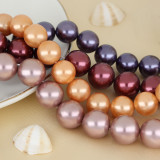
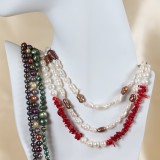
Once most sought by Royal families and aristocrats pearls became every citizen affordable commodity now. The transformation of pearls collecting from pearl beads to farming cultured pearls made a huge difference in affordability. Now buying a pearl necklace became as easy as anything else. These articles will bring you the history of pearls.
What is Natural Pearl?
Contrary to popular belief the natural pearl hardly ever produced by an intrusion of grain of sand into oyster. In reality certain kind of parasite can irritate the tissue of a mollusk that can not be expelled. This process happens by pure accident, these parasites act as irritants causing the mollusk to react by creating a layer of nacre to protect from the intruder. Nacre is nothing but naturally produced crystalline calcium carbonate which gives protection to the mollusk from the intruder. After many years of calcium carbonate build-up nacre will grow in size to form pearl. Unlike Gemstones created deep inside the earth crust, pearl is the only Gem Produced by living animal. Any mollusk with shell can produce the pearls, but not all the mollusks do not always produce pearls unless it is open and have a nutrient rich environment.
Finding natural pearl from oyster beds need luck and skill especially for divers looking for marine pearls, because naturally occurring pearls are extremely rare may be one in ten thousand oysters contains pearls. For centuries people took extraordinary measures by risking their lives to locate the oyster beds hoping to find natural pearls, outmaneuvering dangers from sharks, decompression and jellyfish. These sea pearl oysters live in depth exceeding ten feet, diving for sea pearls is such a hazardous job many countries used slaves to bring the pearl oysters from the sea floor. Natural pearls are rare, older jewelry became primary source of natural pearls now
Unlike marine pearls freshwater pearl mollusks live in streams and sallow rivers and easy to gather. For centuries these freshwater oysters collected for food with little effort. However some Royal families kept pearl beds aside for exclusive use, harvesting these local pearls will buy harsh punishment and death.
Conch Pearls: Are they Pearls?
Pearls are nacre, but there are some non nacreous concretions considered as pearls. Conch pearls produced by queen conch mollusk, calcareous concretion formed in the conch shells very similar to the kidney stones in human body. Even though they were called as pearls technically Conch pearls are not pearls. Conch pearls are small in size usually pink, yellow and orange in color. It is known Conch pearls are extremely sensitive to sun light and the color will fade away.
Keshi Pearls: Are they natural?
Keshi pearls are another pearls without implanted nuclei, these are the by product of rejected implanted nuclei. It is the product of fractured mantle tissue forming pearl which is a natural process. Keshi pearls comes from both salt water and freshwater, unlike cultured pearls Keshi pearls normally small in size the ultimate shape of the pearl vary. Because of total nacre Keshi pearls have more luster to its surface than high quality cultured pearls. Even though Keshi pearls growth is natural, it is not considered as natural pearl. Because of the fact Keshi pearls are by product of pearl culturing, not a natural occurrence.
Real Pearl and Artificial Pearls
Pearl formation is natural biological process; because of the natural process the pearl surface show minor imperfections. These minor imperfections on the surface make us feel gritty when rubbing gently against the teeth. Where as artificial pearls are made of glass beads by coating plastic, mixture of varnish and mica or fish scales, feel slippery and smooth.
Pearl history
Pearl history goes back to more than six thousand years. Ancient Middle Eastern people believed to be the first once who valued the pearls. Later the value of pearls was recognized by the Mediterranean people. According to historians it became such status symbol Romans believed, having a pearl necklace makes them in to high society. Pearls were considered as prized accessory; in fact Pearls were such a status symbol wearing of pearls by ordinary citizens was prohibited. Historian Suetonius wrote the entire Roman military campaign was financed by selling just one pearl from their military general mother’s jewelry.
Hindus in India believe the first pearl was discovered by lord Krishna (4000 B.C). In 1908 George Frederick Kunz book “The Book Of The Pearl” he wrote about his beliefs that fish eating tribe from India are the first people who appreciated the pearls and kept them as valuable commodity. In Arab culture pearl is a greatest treasure from paradise, in Koran it was said “the heavens are filled with glittering gemstones and pearls”. Ancient Greeks believed, giving pearls as a gift brings love between couples. In China Han Dynasty divers retrieved natural pearls by diving into saltwater-dwelling mollusks of South China Sea (200 B.C).
It is interesting to know in some ancient cultures the mother of pearl is more valuable than the pearl. Because luminescent mother of pearl shells considered as valuable and the pearl have little or no value. Even as early as 19th century in Japanese divers did not bother about collecting the pearls instead they collected the mother of pearl shells and left the pearls on the sea floor. It is said the Polynesian children used pearls as marbles.
During Medieval times pearl beads from Russia, Scotland, Germany and Scandinavia produced large quantities of river pearls. These pearls were overshadowed by Persian Gulf sea water pearls later. Pearls from Persian Gulf which has more luster and size where the European pearl can not compete. By 18th century with French and English invasions, Persian Gulf became one of the European sources of pearls.
American Pearls
For centuries Persian Gulf, Red sea, tropical waters of India, Gulf of Mannar and coastal regions of Sri Lanka are well known places for collecting natural sea pearls. The main sources of freshwater natural pearls are in Chinese rivers and ponds. In Western Hemisphere Native American harvested pearls from lakes and rivers. Mississippi, Ohio and Tennessee rivers produced huge quantities of natural freshwater pearls. European colonizers found Native Americans using pearls from rivers and lakes for trade and jewelry. Once the colonizer recognizes the value and volume of pearls available in American rivers, pearls became one of the main products exported to Europe. All of these natural pearl supplies dry up during the nineteenth century. Small quantities of natural pearls are still found in Indian Ocean and Bahrain from wild oysters.
By 17th century United States became main source of pearls to Europe. Unlike then less sophisticated Americans, Europeans know the rarity and value of this lustrous gem. Purchased by kings and queens round high quality pearls made their way in to Royal gem collections. Fuelled by ready market for pearls American mother-of-pearls from Iowa also made their way to Europe for buttons and decorations. Until World War II Iowa mother-of-pearls are the main source for buttons exporting billions of pieces. With the arrival of cheap plastic, buttons made from mother-of-pearl disappeared. While the North American freshwater pearls set a standard in size and quality, salt water pearls from Panama and Venezuela competing with salt water pearls from Persian Gulf and Red Sea. The black salt water pearls from bay of California (now Baja Mexico) became an alternative to Tahitian black pearls.
Spanish discovered the pearl bed one hundred twenty miles north of Venezuelan coast near the islands of Cubagua and Margarita after their arrival to western Hemisphere. Margarita pearls are extremely rare with natural yellow and gold color, these Margarita pearls considered as most prized jewelry. Most recent known Margarita pearl necklace was gifted to Jacqueline Kennedy by then Venezuelan president Romulo Betancourt When she and John F. Kennedy made their official visit to Venezuela.
Until the beginning of 19th century pearl supplies continued to Europe from North and South America. Over fishing of oysters from South American seas and North American streams depleted pearl production, by middle of 19th century industrialization and pollution took a tool on the American pearl beds paving the way from natural pearls to cultured pearls, with the development of cultured techniques Japan became the main source of pearls to the world.
It was estimated around three hundred species of freshwater pearl mussels are native to North America, almost half of them were completely lost, more than fifty species were listed as endangered, around sixty species population declining over the years. Thirty five species of freshwater pearl mussels were lost to extinction in North America in last five decades by districting their habitats and polluting the pearl beads.
Pearls are round?
Pearls comes in different shapes, although most ordinary people think pearls are round, the truth is perfectly round pearls are rare. The size and shape of the pearl depends on five factors.
1. Species of mollusk which produces pearl.
2. How long it took to form the pearl.
3. Nucleus size and shape.
4. Temperature of the water.
5. Chemistry of water.
Even in cultured pearl environment there is no guarantee all the pearl will grow perfect round and large in size.
Pearls are white?
Not all the pearls are white; most of the cultured white pearls are bleached to white from pale pink, pink and off white color. The color of the pearl depend on mollusk and the environment, this vary from white, pink, peach, black, purple, gold to name some.
Where the pearl luster coming from?
One of the most distinctive features of the pearl, ability to glow itself called luster. This unusual reflection not only comes from the surface but also from concentric inner layers of nacre. Because of smooth surface the pearl acts as a convex mirror reflecting the light from surface so it appears to be emitted within the pearl. In some cases multiple layers of surface act like tiny prisms reflecting light, so as it appears to be multiple colors of rainbow.
Pearl Farming
There is not much difference between the farming the crops and farming pearls. Like any other farming it starts with obtaining seed, where as culturing pearls oysters to be nucleated. In early pearl farming days farmers used to collect oysters from rivers and sea beds. Although still the practice continues in some places, many farmers use the method of breeding oysters just like the modern seeds produced for farming. To produce oysters farmers collect eggs and male reproductive cells from oysters already in the farm. These male reproductive cells fertilize the eggs to produce new immature feeding stage insect that undergoes complete metamorphosis. Then the farmers allow them to float these insects freely under controlled conditions for few weeks. The freely floating insect slowly attaches themselves to an object like rock. Over the period of few weeks the baby oyster was born. Then they are collected and moved to separate farms where these baby oysters grow by natural development. Here they keep these oysters up to two years until they were grown sufficiently to accommodate nuclease.
After surgically nucleating, oyster required few weeks of time to recover. During this period some oysters will reject the nuclease, some oysters will get sick and die but most of the oysters will recover. Then the farmers keep the oysters in cages or hang then on the nets. The cages are made of non corrosive mesh 4 feet high 2 1/2 to 3 feed wide and up to four inches depth. Oysters were kept between these meshes like a sandwich, keeping them from four to six inches apart. These nets and cages then moved to oyster beds for pearl farming. Over the time of two to five years these oysters tended to develop pearls. After the development of pearls the oysters will be harvested.
Like any kind of farming, pearl farming depends on skill and luck. Whole oyster’s bed can be killed by uncontrollable natural hazards such as storms. The biggest threat comes from pollution, weather, disease and temperature of water. Even most farms try to control many factors by installing barriers from high tides, moving pearl beds to less polluted places and keeping constant watch on the oyster health, still pearl farming always a risky business with many variable possibilities.
Color of the pearls
The first process for marketing the pearls start with cleaning and polishing pearls and then it moved to grading pearls by size and quality by trained employees. Most of the pearls go through bleaching process to enhance the whiteness; some pearls are dyed to different colors. The dyeing process includes keeping the pearls in chemical jars for several days and dyeing with colors. In chemical dyeing process pearls kept in half filled chemical solution jars, the other half filled with pearls. Factory chemists use different chemical combinations to obtain different colors. Since pearls came from living animal, all the pearls do not react the same way. Imagine all of us do not get the same tanning even we stay at beach absorbing same amount of sun light.
Most of the freshwater pearls were strung first and dropped in to the chemical jars, where as sea pearls were treated first and made in to strands later. We can see some freshwater pearl strands with chemically reacted black threads instead of normal white thread. Most popular silver, peacock and black color freshwater pearls treated from natural peach color pearls.
Color of the pearls
The first process for marketing the pearls start with cleaning and polishing pearls and then it moved to grading pearls by size and quality by trained employees. Most of the pearls go through bleaching process to enhance the whiteness; some pearls are dyed to different colors. The dyeing process includes keeping the pearls in chemical jars for several days and dyeing with colors. In chemical dyeing process pearls kept in half filled chemical solution jars, the other half filled with pearls. Factory chemists use different chemical combinations to obtain different colors. Since pearls came from living animal, all the pearls do not react the same way. Imagine all of us do not get the same tanning even we stay at beach absorbing same amount of sun light.
Most of the freshwater pearls were strung first and dropped in to the chemical jars, where as sea pearls were treated first and made in to strands later. We can see some freshwater pearl strands with chemically reacted black threads instead of normal white thread. Most popular silver, peacock and black color freshwater pearls treated from natural peach color pearls.
Cultured sea water Pearl
Thousands of years of pearl history were rewritten with the discovery of pearl culturing. A Japanese noodle maker son Mikimoto completely changed the pearl industry. By trial and error over a number of years Mikimoto experimented by inserting wood, clay, glass and other round bead objects in to mollusk to make round pearls. He later discovered highest success rate came from the mollusks when he inserted nuclei cut from the U.S mussel shells. Mikimoto and his wife started producing round cultured pearls on demand which were never thought imaginable. For last one hundred years U.S mussel shells are the basic for almost 95% cultured salt water pearls.
Historically pearls are possessions of Royalty and aristocracy. With the arrival of cultured pearls it became available to every ordinary citizen. Now pearl farmers can cultivate great quantities just like farmers produce fruits and vegetables. Hunting and diving for natural pearls still exists in some parts of the world like Bahrain with very limited success. Decline in price of pearl made it difficult to invest on finding natural pearl beds.
Freshwater Cultured Pearl
Freshwater cultured pearls are different from the salt water cultured pearls. Unlike salt water pearls freshwater pearls do not have any bead nucleus. To culture freshwater pearls less than one year old mussels were used. By slightly opening freshwater mussel’s shells, farmers cut the mantel tissue inside the both shells and insert small peace of live mantel tissue from another shell. Then the mussels are returned to their environment. This alone creates enough irritation to start nacre production. The insertions in freshwater pearls are 10 to 20 per each side of mussel for a total production of 20 to 40 pearls per mussel.
Everyone have pearl necklace
In the beginning accepting of cultured pearls are not that easy, most of the buyers rejected culture pearls until 1930. Most notable designers like Coco, Chanel and others used them in casual designs. After the World War II the trend had changed, combined with aggressive marketing skills of Mikimoto and wide range in colors and sizes, designers were able to create sophisticated pearl jewelry. Now pearls are everywhere worn by ordinary people to movie stars. With the arrival of affordable Chinese cultured freshwater pearls we are living in the great age of pearls. In fact the pearls never lost their luster still they are as glamorous as ever, an elegant look for any occasion.
Potato and semi-round shape freshwater pearls.
Freshwater pearls entirely nacre just like natural pearls. This makes fresh water pearls rarely perfect round. Most of the pearls sold as round freshwater pearls are not round they are semi-round called potato pearls because it shape resembles potato.
Biwa Pearls
Biwa pearls are native to Lake Biwa in Japan near Kyoto. This four million years old lake also known as Lake Omi spanning around 300 square miles providing dirking water for 15 million people is the first lake to produce cultured freshwater pearls. At the beginning of 20th century, farmers experimented with native pearl mussels to culture freshwater pearls; the successful use of Lake Biwa mussels for almost seventy years gave the name to freshwater pearls as Biwa pearls. All the freshwater cultured pearls were named after Lake Biwa even though they were cultured elsewhere until the Chinese started cultured pearl industry. With over harvesting and pollution native Biwa mussels became virtual extinction. Now Biwa Lake produces very little cultured freshwater pearls in cross between remaining Biwa mussels and closely related Chinese mussels.
By passing environmental regulations in 1981 agricultural and industrial use was restricted near Lake Biwa. Now word Biwa pearls are used to identify flat freshwater pearls produced by Chinese farmers. With an inserted flat shell peace in to mussels Chinese produce flat pearls.
Coin shape freshwater Pearls
Coin pearls are produced similar way as flat pearls by inserting a round shell peace into mussels. Since the flat and round pearls are thin and large in size than other freshwater pearls, not all the pearls are collectable most of the pearls stick to the shell witch makes these pearls more expensive than other freshwater pearls.
Akoya Pearls
Akoya pearl oysters are the smallest pearl producing oysters native to Japan, these small oysters can produce near round pearl with high rate of success. Because of consistency in size and quality Akoya pearls became popular among the jewelers making them ideal for matching. In general the term Akoya became any bead nucleated cultured sea pearl from Japan and China now.
Tahitian pearls
Contrary to popular belief Tahitian pearls are not from Tahiti, actually there are no pearl farms located on the island of Tahiti. Instead the farms are located through out French Polynesia and Micronesian islands and auctioned at Tahiti which is the main commercial hub for Tahitian pearls.
Tahitian pearls are produced in a black lipped oyster, these large oysters are up to one feet long weighing up to 10 pounds witch often producing large size pearls. Most people believe Tahitian pearls are black, actually they are not black instead they come in range of colors from gray with green, charcoal with blue and rose overtone and silver. True black pearls are extremely rare; most of the black pearls worn by European renaissance came from Baja California and Panama.
South Sea Pearls
South sea pearls comes from two species knows as gold lipped oyster and silver lipped oyster, these are the largest pearl producing species in the world. Even though biologically these two oysters belong to the same species, they produce different color pearls, in Australian coast silver and white color while gold color pearls coming from Philippines coast. South Sea pearl nacre is two to three times thicker compared to Akoya cultured pearls and as large as 20 mm in diameter compared to other pearls. South Sea pearls have more luster than any other cultured pearl which makes them unique.
Mabe Pearls
Mabe pearls are blister pearls formed on the shell rather than its soft tissue. Inserting hemispherical shaped object between the tissue and shell causes the body of oyster to produce layers of nacre, these blisters later cut from the body of shell.